Monday, November 12, 2012

Our changing climate

In the wake of Superstorm Sandy, I, along with many others, have been thinking about climate change. I was engaged in a conversation just the other night with a family friend who does not subscribe to the argument that indeed our planet is warming due to increased emissions of CO2. So I asked him, "Why do you choose not to believe in it?" He immediately replied by asking me why I do believe.

I believe for three reasons.

First, I have concern for future generations of humans, wildlife and plants and the overall life of the planet. I do not want us or them or it to become extinct prematurely. Just as I exercise regularly to be sure I live long and prevent premature death, or someone quits smoking cigarettes or another person receives heart bypass surgery to do just the same, I am willing to take action to prevent the premature extinction of our earth and its inhabitants.

Second, I am a scientist. I have read research on global warming and climate change and understand the use of statistical models to predict the future, and based on my read of the decades of evidence, see a potential for truth. In other words, the evidence is strong enough to me that I reject the possibility that the patterns we are observing are happening by chance alone.

Third, I appreciate the argument's ability to raise ecologic consciousness. If I choose to believe that the warming of our climate, rising of sea levels, and melting of ice caps are a result of me and my fellow humans, it makes me very conscious of what I do on a daily basis. What natural resources do I consume, and can I potentially reduce my consumption? How far do products travel to get to me, and can I choose local purveyors to reduce that travel time? This daily self-reflection, I think, is healthy, because it makes me consider things in a broader perspective. It connects me to so many layers and nodes around the globe and empowers me to realize that what I do matters.

My friend's response to my question of why he chooses not to believe can be boiled down to two reasons, unfortunately (mind you, I'm boiling them down): because the solution costs too much and he doesn't like being told what to do. It's a fascinating response, and I wonder if there are other reasons to shrug off the evidence of climate change... in spite of the storm that flooded NY and NJ after years of rising sea levels and a changing jet stream. I am very willing to listen.

Friday, November 9, 2012

First roast

It's getting cold outside, so we decided to enjoy a nice roast chicken - eating the first bird that we harvested a few weeks ago. It was tasty and substantial and we can't wait to appreciate more!

First roast

Recipe with roots

Glazed roots (such as turnips, or carrots, radish, rutabaga, parsnips)

Ingredients: turnips, butter, sugar, water

Preparing: Cut turnips to desired size. Melt a few tablespoons of butter in a shallow pan. Add turnips, sugar (can use brown or white sugar) and water (can use broth) and a pinch of salt. Cook on low heat, partially covered, until the water has evaporated and the turnips are glazed (the longer you cook the more caramelized the turnips will be- but be careful not to burn!).

Eating: A good side dish to add to your Thanksgiving table.

Dish history: Our take on the classic glazed carrots. You could mix a variety of root vegetables, I'm sure, but be careful of different cooking times. You could try honey or maple syrup as the sweeteners, too.

Tuesday, November 6, 2012

There's always time to vote

After a long day of mulching and covering up vegetables, we voted. Hope you did, too.


Sunday, November 4, 2012

Fall happenings

Nick clearing the West field
Gathering mulch for beds


We are starting to close up shop. We've got parsnips, carrots, beets, turnips, leeks, lettuce, collards, spinach, parsley, scallions, Brussels sprouts and cabbage still in the ground. But all the rest of our vegetable beds have been put to bed, with hefty doses of manure (thanks workationers!), compost and mulch. Nick is clearing a new field to the west of our garden where we will put our pigs this spring. The hens have been moved to their winter housing. We are burning the burn piles in the orchard space so we can bring in our friend with an excavator to dig 30 tree holes. Our roofing material will be delivered on Monday so we can complete the wood shed/rain harvest roof. And we are planning out the foundation for our future greenhouse. This point in the season is really a race against snow cover...

Putting the beds to bed
Hens in their winter coop
Wood shed waiting for roofing

Saturday, November 3, 2012

Recipe with squash and greens

Squash and greens


Ingredients: winter squash (butternut, acorn, etc.; could even use sweet potato or yam), greens (collards, chard, spinach, etc.), bread (can be stale), garlic, cumin, salt, pepper, olive oil, red wine vinegar

Preparing: Peel and cut a winter squash into cubes (the size of a dice; we used butternut). Put in baking dish, drizzle with oil (don't be stingy) and bake at 350 for 30 minutes (until perfect, not falling apart and not too hard). Meanwhile, in a saucepan heat olive oil (1-2 Tbsp). Cut bread into cubes (the size of dice) and fry in the hot oil until nice and brown. Add a bit more oil if necessary and add sliced garlic (3-5 cloves), ground cumin, salt and pepper. Cook until garlic has browned (which will give a nutty taste and aroma). Then pulse bread/garlic mixture in a food processor or blender to make breadcrumbs. In another, larger saucepan, heat some olive oil and cook chopped greens (we used collards). Once desired texture (collards took about 10 minutes), add 1-2 Tbsp vinegar (we used red wine vinegar) and cook off a bit. Add breadcrumb mixture and mix well. Then add squash and mix gently.

Eating: Great with a steak.

Dish history: Found this recipe and adapted it to use some of our sweet butternut squash and frost-kissed collards. It's a great way to use up some stale bread, too. The toasted breadcrumbs really make the dish.

Friday, November 2, 2012

Using all of the parts

I hate wasting. I'll even re-use a piece of saran wrap or a pretty clean paper towel. So it's no wonder that I try to make use of all of the parts of the food I cook. I do things as obvious as making a stock out of a chicken carcass or toasting croutons out of stale bread, and will even be adventurous and use carrot greens and fennel fronds.

With recent estimates warning us that Americans waste nearly 40% of our food, I wish that some others might start to hate wasting as much as I do. Sometimes we waste because we buy too much, we over-consume, our shopping carts are bigger than our family's stomachs. And so food gets thrown out with the garbage. Other times we just can't be bothered to make use of it all - how many of us have been guilty of not making turkey soup after Thanksgiving? And a lot of the time we just don't have any idea what to do with all of those parts. It takes time and energy to be creative with your onion ends, flat beer and watermelon rinds.

That said, there are some things even I haven't figured out how to eat myself... and so there's always pets and composting.

Monday, October 29, 2012

Recipe with butternut squash

Butternut squash ravioli

Ingredients: Pasta (2 c flour, 2 eggs, 2 egg yolks); Filling (butternut squash, sage, mozzarella or ricotta cheese, garlic, salt); Sauce (butter, shallot, sage, cream, maple syrup, salt)

Preparing:
To prepare pasta: I use Alice Waters' recipe and technique. Simple.
To prepare filling: Put a little bit of water in a baking dish and put whole butternut squash in. Bake at 350 until tender. Once cool, scrape out flesh of squash and mash with mozzarella or ricotta cheese. Smash garlic cloves with salt and add that to the squash, along with some chopped sage.
To prepare sauce: Melt about 4 Tbsp butter. Saute diced shallot. Add small sage leaves once the butter has started browning a bit. Add about 1 cup heavy cream and a drizzle of maple syrup (to taste). Whisk for a minute or so, add some salt to taste, and you're done.

Eating: You can't eat pasta without some fresh parmesan.

Dish history: I finally made use of my pasta machine and it made me realize how easy it is to make your own fresh pasta. We usually eat our butternut squash ravioli with a brown butter/sage sauce, but we decided to try this more decadent sauce. Double the recipe and freeze your leftovers for another day.

Recipe with carrot greens

Carrot top "seaweed" salad (adapted from Melissa Clark)

Ingredients: Carrot greens, sesame seeds, soy sauce, mirin, sake, sugar

Preparing: Cut off greens of carrots (cutting off most of stem, too) and wash well. Blanch greens in salted water for 2 minutes and then plunge in ice water to stop cooking. Then soak greens in cold water overnight, changing the water about 3 times (this removes the bitterness of the greens). The next day, drain and cut greens to 1-2 inch pieces. Make dressing: Toast 3 Tbsp. sesame seeds and grind into a lumpy paste (if you can't grind all seeds well, then drizzle some sesame oil into the dressing), and mix with 1 Tbsp soy sauce, 1 Tbsp sake (or white wine, if you don't have sake), 1 Tbsp mirin and 1/8 tsp sugar (or up the sugar amount a bit, if you don't have mirin). Pour dressing over greens and let marinate for at least an hour before eating.

Eating: Tastes delicious with any Asian-inspired meal or otherwise.

Dish history: We were visiting Jason's sister to celebrate his niece's birthday and we decided 7 bunches of carrot greens couldn't go to waste, so we tried out this recipe at the party. It really does resemble seaweed salad (mainly because of the dressing and color) and accompanied delicious sloppy joes and tabbouleh salad.

Wednesday, October 24, 2012

Recipe with pumpkins

Roasted pumpkin tacos

Ingredients: Pumpkins, tortillas, various fresh veggies (radish, cabbage, onion, scallion, parsley, cilantro, ginger, etc), roasted pepitas (pumpkin seeds), cheese, sour cream, lime juice, hot sauce

Preparing: Wash your pumpkin, cut in half, scoop out seeds (and roast them with salt while you are roasting the pumpkins!) and cut into wedges. Coat wedges with some oil and sprinkle with salt and a spice (we use homemade garam masala, you can use cumin, oregano, cinnamon) and roast in a single layer at 350 for 40 minutes or until tender. Meanwhile, chop up your fresh veggies as taco toppings.

Eating: We make our own homemade flour tortillas, melt some cheese on them, throw a pumpkin wedge or two on there and then top with anything we can get our hands on.

Dish history: We made this for a local farm-to-table event and they were a hit! We leave the skins on the pumpkins since they were grown organically (in fact, the roasted skin is the best part). And we top the tacos with our homemade hot sauce. Enjoy!

Recipe with flour

Flour tortillas

Ingredients: Flour, milk, vegetable oil, baking powder, salt

Preparing: Mix together 2 cups flour, 2 tsp. vegetable oil, 1.5 tsp baking powder and 1 tsp. salt. Slowly add 3/4 cup warm milk. Stir until sticky ball is formed and knead on floured surface for 2 minutes. Cover dough for 20 minutes. Then break off 8 sections, roll into small balls, cover and let rest for at least 10 minutes. Now you're ready to roll out each ball on a floured surface and cook on a hot-hot-hot cast iron skillet for ~30 seconds each side.

Eating: Perfect for tacos, burritos, enchiladas, etc. The hot-hot-hot cast iron skillet (with grill ridges, if possible) is really key, as it blackens the tortillas a perfect amount.

Dish history: While living in Argentina we would get serious cravings for tacos. And there were no ready-made tortillas readily available. So we found this recipe that uses wheat flour (as opposed to corn flour which we also could not find anywhere) and are always happy with the outcome. Nothing beats a warm, freshly made tortilla with your taco fixings.

Monday, October 22, 2012

Organic vs. Local

I have been asked so many times what I think is "better"... organic or local?

Hands down, my first answer is "both." There are small, local farms popping up all over the place, and the majority of these farms farm organically. That's organic with a little "o"... the uncertified organic practices that rely on crop rotation, manures and composts, integrated pest management and other ancient ecologically non-degrading practices, but haven't spent the years or $$$ to become official with a big "O."

If you can't have both (even though you can, see websites such as this to find the dynamic duo near you), then it's time to weigh the pros and cons.

Going local might mean you actually know your local farmer and can ask him/her directly about their practices. You can find them at farmer's markets or driving on secondary highways. They may not be able to label themselves as Organic, but their practices might be. But sometimes these local guys run conventional farms, which means they use inorganic pesticides, herbicides and fertilizers. And this is a tradeoff that we make, that we consumers should consciously grapple with when we purchase our vegetables, fruit, and even honey and wine.

Going organic might mean your foods are (nearly) inorganic pesticide/herbicide/fertilizer-free. This is good for your health and the health of the environment. But a lot of times the organic avocados, lettuce, celery and other produce we buy in supermarkets comes from humongous farms across the country or even the world. So what we spare in runoff into our water and waste streams, we contribute to in carbon footprint as our produce travels thousands of miles just to get to us (not to mention heavy irrigation, or unfair labor practices, etc.; see this article for some commentary). This is a tradeoff that we make.

There is considerable debate on this issue that continues in journals, the media and around dinner tables. I say go with your gut. Let's actually think when we make purchases about what values we want to uphold. And rather than ignore the part we play in modern agriculture's destruction of our ecology, get active each and every time we make that exchange of $$$ for food.

Friday, October 19, 2012

Week 20 CSA basket

Thank you for joining us for our first CSA season! We learned a lot and grew a lot and are so grateful you were a part of it.

Expect the following this week:
Butternut squash, potatoes, parsnips, garlic, chard or spinach, parsley, scallions, sage, oregano, cabbage, pears, beets, fennel and kale.

The pears come from this property's century old pear trees that are dripping with fruit that stores well, bakes well and tastes delicious.

We hope you enjoyed this season's bounty. We were so happy to share. Until next year...

Friday, October 12, 2012

Week 19 CSA basket

Expect the following in this next-to-last basket:

Butternut squash, potatoes (fingerling, Austrian crescent, alba baking), lettuce, parsley, kale or chard, tatsoi cabbage or bok choy, parsnips, turnips.

We have a huge bounty of butternut squash, thanks to PJD's plot. We just harvested them yesterday, so it is best to put them in a warm, sunny spot in your house for about 1 week to "cure." This helps the outer shell harden for long-term storage. Your butternut squash can last until the spring if you store it in a cool, dark place once cured (not your fridge).

Wednesday, October 10, 2012

A taste of our harvest

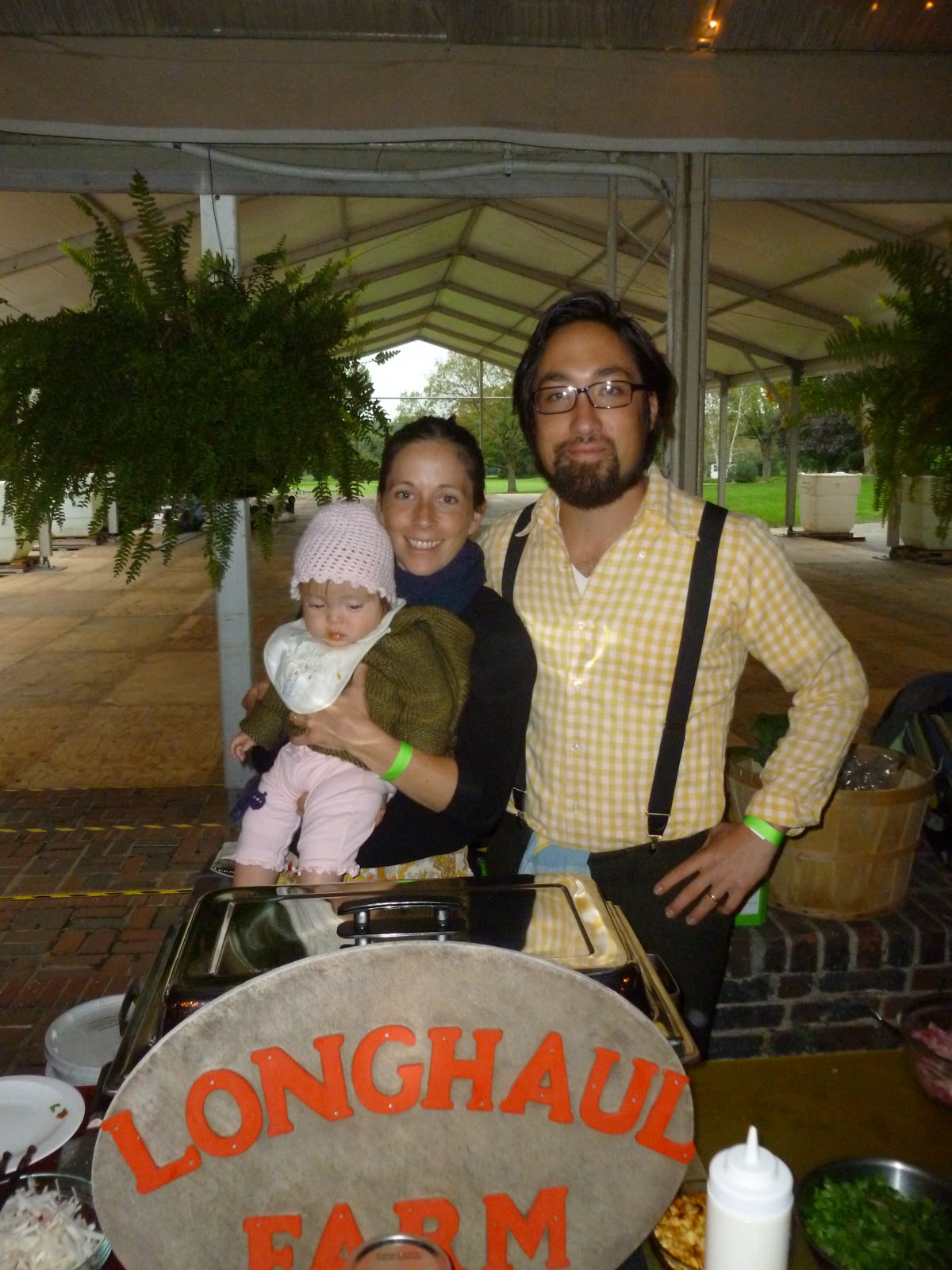
Longhaul Farm participated in the "Taste Our Local Harvest" event at the Westchester Country Club this year, showcasing our produce and cooking skills. Farmers were paired with local restaurants to create a "farm-to-table" experience for patrons, and in our case, we were both the farmers and the chefs (or, cooks, as I'd prefer to call myself). We cooked up a roasted pumpkin taco with all of the fixings... which was really just a vehicle to taste our homemade salsas: mild salsa verde, medium sriracha, and hot jalapeno sauce.

Crowd responses were positive, showing interest in our Supper Club, devouring our hot sauces, converting to pumpkin, and expressing amazement that we could do it all with a 7-month old in tow. We had very special help at the event - couldn't have done it without Jason's oldest niece, who womanned the tortilla-warming station and added super positive energy.


Monday, October 8, 2012

Recipe w/ hot peppers

Longhaul Farm's "sriracha" sauce

Ingredients: 1.5 lb. hot peppers, 3/4 c white vinegar, 3/4 c water, garlic or scallions, 3 Tbsp. each salt and sugar

Preparing: Cut your hot peppers. For a hotter sauce, include seeds and membranes. Blend your peppers with garlic (about 10 cloves) or scallions (about 5), vinegar and water. Add salt and sugar and simmer in a wide pot for approximately 20 minutes. Once cool, re-blend for a few seconds to desired consistency.

Eating: Use this on anything... tacos, eggs, rice, pastas, pizzas, bagels, greens, soups... whatever you'd put your sriracha on.

Dish history: We had a serious abundance of hot peppers this year... they are prolific! And this year's harvest was H-O-T. We made a green sauce with jalapeno and a red sauce with red portugals. And we've finally perfected a recipe. Enjoy!

2012 Work-ation / October-fiesta

The rain stayed away and our people came ready, willing and able. We had 70 visitors over the course of the day who got down-n-dirty with farm work. Thank you for all of your time, sweat, labor and friendship!

Together we accomplished: skimming and prepping 10 new vegetable beds... hauling 6 truck-loads of horse manure... mucking out 2 dump-trailer-loads of sheep manure... shoveling a trailer-load of (ripe) goat manure... collecting 2 truck-loads of wood chips... creating a huge compost pile...harvesting over 250 pounds of potatoes, 35 pounds of hot peppers, 20 pounds of tomatillos, 80 pounds of squash and pumpkin and 15 pounds of daikon radish... wheeling 120 wheelbarrows of manure and compost... prepping 40 beds for the winter... clearing brush for the pig pen... and burning a huge brush pile into a lovely pile of ash for the garden. This is work that would have taken the 2 of us weeks to accomplish. Not to mention our great cooking team who prepped 80 cups of tomato soup, 70 baked potatoes, 10 quarts of beef and pumpkin stew, 50 ears-of-corn-worth of creamed corn, a huge fresh salad and 50 whoopie pies for dessert.

It's good to get outside and work on those muscles, but it's even better to join a community in some teamwork and camaraderie. We hope you enjoyed yourselves and will come back for more in April 2013.

Thank you again... enjoy some shots from the day:


Friday, October 5, 2012

Week 18 CSA basket

We are coming to the end of our first season. No frosts in the forecast this week, so we are holding off on parsnips and the cabbage family. And these rains have put our popcorn harvest on hold, too. Let's hope for some dry, sunny days.

In your baskets this week:
Fingerling potatoes, pumpkins, onions, bok choy, Napa cabbage, spinach, chard, parsley, lettuce, peppers.


Thursday, October 4, 2012

No more wake-up calls

This past weekend we harvested our 5 remaining meat birds. They were causing too many problems with our laying hens after we had to house them in closer proximity following the massacre a few weeks back.

It was intense. Jason was a pro at catching the birds and eviscerating them, but couldn't handle the actual kill... left to yours truly. The de-feathering was such a chore compared to the last time I did this, where the facility had a centrifuge that spit out bare birds in 20 seconds. But thank goodness we had the help of a friend!... and the audience of her 22-month-old and little Seneca added to the festivities. It is certainly interesting to imagine what was going through their little brains as they witnessed the production.

Plucking the chicken
So we are now down to our 24 laying hens. There are no more wake-up calls in the mornings, with the crowing roosters now gone. Some neighbors have commented on the silence. I hope they enjoy it now... we've got 15 new chicks in the brooder getting ready for their life on the farm.

Wednesday, October 3, 2012

The security in farming

I haven't met any other farm owners in the Hudson Valley who don't have a day job off of the farm. It's just the simple economics behind it - food is cheap in our society and you can't make enough off of it to completely support your family.

But what small-scale farming lacks in income earnings, it makes up for in security.

Today's labor market is becoming increasingly unstable. Unemployment is up, retirement packages and pension plans are disappearing, workers are asked to bear even bigger portions of their health insurance costs, and worst of all, many jobs are expendable and reaching obsolescence. Add to that heavily indebted personal expenses, full of mortgages, credit cards and loans and a declining savings rate. So when one has a job and an income that covers expenses, all is good. As it should be.

But that's not always the case, and increasingly so. A friend of ours just disclosed to us that he has been laid off and has 90 days. He is middle-aged, with a mortgage and children, and had relocated his family for this job. Can you imagine the shock and fear in his life right now? Another friend of ours is stuck in a job she hates because she relies on the health insurance, the income to pay off her loans, and is committed to her 401k plan that will hopefully see her through retirement. But is she happy?

The jobs we have here off of Longhaul Farm are equally as precarious. And although the income we bring in from them is essential to us maintaining our lifestyle as we now live it, we are privileged to know that we could live with less because of our farm. Our farm, which brings us food, community, happiness, activity and a few customers. It is a great sense of security in this stage of the economic game, where people are no longer lifers in a company with retirements to look forward to nor have the ability to pay off mortgages in a lifetime. And most of all, we enjoy the work, the satisfaction of production, the sustaining food... and the long, relaxing winters.

So are we secure? Thankfully, yes. This farm gifts it to us.