Tuesday, May 29, 2012

Insect pressure

Be-headed pepper seedlings
Although I enjoyed never having to shovel snow or wear my long underwear this winter, I am now (cursing it, and) understanding what the implications of such a mild winter are on farming. Sure, spinach, kale, parsley and arugula all survived uncovered. But edible greens weren't the only things to experience an extension on life.

Insect pressure has been fierce this spring. Slugs, which can lay up to 500 eggs in a season and thrive in temperatures above 40 degrees, have annihilated over 300 of our lettuce seedlings, 200 basil seedlings, and have flattened several flats of peppers and eggplants. We now have nightly missions in the garden at dusk picking slugs, some the size of pearl couscous and some as long as a pencil. We throw them with anger into a jar of salt water and watch them perish. 
Slugs!

We have a few volunteer cucumber seedlings sprouting in places and when I reached down to pull them up I saw a curcurbit's worst nightmare: the cucumber beetle. In fact, I saw several of them, even some mating. These pests are harder to abolish than the sluggish slug. They seem to sense you coming and fly away or bury themselves into the soil quickly. I have to go out at 6 in the morning to really catch them at their slowest time.


Salting slugs
And today we were in for the biggest blow of the season so far. We had a bed of beautiful lettuce mix growing, which we meticulously weeded 5 days ago. We were counting on it since the slugs demolished our head lettuce seedlings. But I noticed this morning small sections of the rows eaten down. The stems of the small leaves were still standing, but there was no more leaf. As I peered closer I saw too-many-to-count-or-want-to-think-about caterpillars munching on our lettuce. There were several different varieties, but mostly the cabbage worm. These are easy to squish between your fingers, but with so many, we had to just till the lettuce in and start all over again (after I had myself just a little joy of squishing as many as I could in 15 minutes).

Can you see those caterpillars demolishing our lettuce?


Saturday, May 26, 2012

Eating seasonally

Eating seasonally is a skill. Trust me, to deprive yourself of fresh tomatoes for all but 2 months a year takes practice and patience.  (Well, not really, because who wants to eat those tomatoes grown in Florida's sand, picked green and hard as a rock, and brought hundreds of miles to your supermarket shelf, only to taste like mealy water the other 10 months of the year?)

Right now we are at the end of our "spring hunger gap" and starting to eat fresh vegetables again. We've polished off all of our frozen greens, pickled vegetables, and stored beets, potatoes and squashes. Our canned tomato sauce is running low. And I used the last of the blueberry jam to make a syrup for some homemade ice cream. Finally, wee have spring greens, herbs and chives coming up in the garden and the salad we had for dinner couldn't have tasted any fresher.

But our current food system has deprived most of us of the sheer joy of eating asparagus for just a few weeks a year, for example. Our culture of food has allowed us to have our favorite vegetable at any meal, any time... but so much so that it is no longer our favorite vegetable anymore.

Eating seasonally is a challenge, not only for your taste buds, but also for your cooking. (There are only so many ways you can make celeriac and rutabaga.) But it is so rewarding, because that first juicy spring peach is a little taste of heaven every year. It really makes you appreciate life and nature, and most importantly, food.

Friday, May 25, 2012

Recipe with scapes

Scape and raab pasta sauce

Garlic scapes
Ingredients: Garlic scapes, broccoli raab, sundried tomatoes (optional, or other vegetable of your choice), olive oil, hot pepper flakes, s + p

Preparing: Be sure the tough part of the scapes and raab are broken off (they generally break at the tender point like asparagus does). The rest is easy: saute vegetables in olive oil. Add a bit of the pasta water before stirring in the pasta.

Eating: Top with parmesan cheese and fresh lemon juice.

Dish history: Early garlic scapes and raab are harvestable at about the same time. The best part about scapes is that you get a similar garlic taste to your dish, but you don't have to peel and mince any garlic.

Tuesday, May 22, 2012

Wild life

As we were finishing up our outdoor work today we heard some squawks from the chicken coop. We didn't think much of it at first, but then Jason went up there to check it out and found a terrified crowd of chickens and a hawk stuck in the electric fencing. I've never been that close to such a huge, beautiful bird. It was scared of me and Jason and kept flying deeper into the netting, but eventually freed itself when we chased it from the opposite direction. Even though it is preying on our chicks we were happy to see it flying high in the sky again.

Sunday, May 20, 2012

2012 member gathering

We had our 2012 season kick-off CSA member gathering this weekend. It was a great opportunity for us all to meet each other, enjoy some food + drink together, and build some community spirit. Thanks to all who joined, and for those who couldn't, we hope you can next time. This will certainly become a tradition!
Enjoying some food, drink + conversation
The spread of food

Visiting the chickens

Tuesday, May 15, 2012

Potatoes-in-a-barrel

See these 2 blue barrels? They've got a hefty layer of compost and leaf mold in them with some French Fingerling potatoes buried in. As the potato plants grow past the compost-line, we just throw on more compost and more potatoes will grow. Once we hit the top we'll harvest a whole barrel of potatoes... a technique we learned a la John Seymour.

Sunday, May 13, 2012

Remay, remay, everywhere

Row cover is an organic gardener's best friend. Or so they say...my best friend wouldn't make my beautiful garden look like a sea of white cloth. But I suppose it is doing its job of minor frost protection and keeping flea beetles and other insects away from our seedlings. Once the young plants are established we'll be able to remove a lot of it, but the brassicas tend to need them all season long.

Tuesday, May 8, 2012

Halfway planted

Onions
This weekend we hit the halfway mark: 50 vegetable beds planted out before the last frost date in the Hudson Valley (being near the Hudson River and on the northern tip of Westchester County, we have an earlier date than most of the Valley). That means peas, greens, roots, beans, herbs, potatoes and the onion family are happily nestled in their beds. The next few weeks will be full of transplanting those heat-hungry yet frost-sensitive vegetables: tomatoes, squashes, melons, peppers and eggplant.

We're also recently obsessed with building our greenhouse, having grown out of our cold frame. Drafting up plans now and we'll hopefully start building next week. In our spare time...
Chives

Trellised peas + radishes

Asparagus

Lettuce starts

Sunday, May 6, 2012

CDs + scarehawks

Our electric fence might keep our chicks in and ground critters out, but it is no match for the mighty hawk. We've lost two already to these birds, who live above the coop in the tall red pines. We're trying two tricks to keep the predators away... we've strung CDs across the pasture the chickens are foraging in and posted a scare-hawk. Our guide to raising chickens suggested the former method, saying that the sun and wind would move the CDs enough to scare away a hawk or other flying thing from getting too close (this method might not be successful on cloudy, still days... in fact, we lost one of our chickens on such a day with our CDs already strung). And we dressed a fence post in a scary trench coat and hat to see if it might guard our future egg-layers.

Tuesday, May 1, 2012

Work-ation Spring 2012

This past weekend 40 people gathered to help us with our spring work. In our morning session we dug 5  vegetable beds, hauled away dozens of rocks, prepped 750 square feet for potatoes, planted hundreds of onions and created an eye-high compost pile. After lunch, a small group planted 20 pounds of potatoes and the rest of the crowd walked up the road to our additional growing space and prepared 15 brand-new beds for spring planting.

It's amazing what a crowd of people can accomplish together in just one day.

Thank you to all who joined! Looking forward to the next work-ation this fall.


Sunday, April 22, 2012

Mulch nightmares

It is hard to admit it, but we are really battling our mulch. Last year we thought we had hit the jackpot with chopped leaves and sheep-manure-hay. As we prepped the vegetable beds for their winter dormancy, we slathered on the stuff... I mean, trailerloads of mulch, piled on every bed. And when we got back out in the fields this spring... a farmer's nightmare came true: everything looked exactly as we had left it.

We are not the only ones dealing with the aftermath of a mild, snowless winter. Other farmers I've talked to have said the same thing. None of the expected organic matter got broken down these past few months without a snow cover. And coupled with almost no rain in March, we are all scrambling to prepare our beds... some farmers around here are even starting to water their garlic (almost unheard of).

We have wasted spent many person-hours this past month removing the mulch, only to see that none of it has composted, that the lime we worked in hasn't even dissolved, that none of the sod has rotted. Woe is us, we are now hauling trailer-load after trailer-load of mulch to our already humongous piles of compost material. And almost no organic has been added to our beds.

Mother Nature, won't you give us a break? Bring us some rain and we'll take good care of your land.


Sunday, April 15, 2012

The hand is coming back

Or so says celebrity chef, Mario Batali, in a well-written call-to-arms article in Lucky Peach. He's referring to the return to American craftsmanship, where we actually make things with our hands... take pride in cooking a fantastically delicious meal, transplanting seedlings or building your own bookshelf, buying stuff from someone you actually know, learning how to fix things, using your fingers for more than just tapping away at the qwerty keyboard.


I used to think it was weird that I didn't have any "hobbies" to speak of, and when someone asked I would say, "I cook." But now that I can look at it as my opportunity to dabble in the artisan world, I feel even more inspired to be adventurous with my ingredients and taste combinations.


We have a lot of friends and acquaintances who do amazing work with their hands. Some of them have "gotten out of the corporate world" and are getting down and dirty by starting their own businesses, working in forgotten fields, renovating their houses, building green roofs, making music and art. I think more handy-work is just what this country needs. It not only creates work opportunities, it restores a sense of purpose.

And that's what we're all about... re-purposing life.

Tuesday, April 10, 2012

The chicks are out

Our chicks have been growing strong in their brooder boxes for 5 weeks now. In fact, they've been out-growing their boxes, so we decided to move them out into their bigger home in the red pine field. We finished the mobil-coop last night - tarping off the top and adding a door - and dragged it up with the ATV to a grassy spot. As soon as they had the chance they starting flapping their wings and flying around, at first pecking their feeders for food, but quickly realizing that the entire ground was a potential food source. Be free and be strong! 

Saturday, April 7, 2012

Spring transplanting

 We've been transplanting out lots of our early sown seedlings - kale, collards, chard, spinach, lettuce and leeks. They are all protected under hooped-up greenhouse plastic. And even baby Seneca came out with us to enjoy some sun and spring breeze.

Thursday, April 5, 2012

Have a heart

Jason found two large holes in the ground near our compost pile and we knew there was some critter just waiting for us to plant out our delicious little spring seedlings. So we set out the hav-a-hart trap with some green beans and salmon skin last night, and behold, we found a nasty creature in it this morning. The bare tail, claws and rather large teeth gave it away: an opposum. This kind of trap lets you release the animal somewhere without having to kill it. So we're checking with local regulations to see if there are any restrictions on where it can go... we're hoping it will be across the Hudson River, far from our kale and collards.

Tuesday, April 3, 2012

Garlic's up

Our garlic is looking great. I was worried with the warm weather we've been having that they were growing too quickly, but our local garlic expert told us not to worry, that the shoots should be coming up about now. Looking forward to a July harvest.

Saturday, March 31, 2012

Nature deficit disorder

I often lament the over-medicalization of things, but I recently learned about a concept that put into words a modern societal problem I've grappled with for the past few years.**

In 2005, Richard Louv coined the term "nature deficit disorder," referring to the increasing trend of children spending less time outdoors, resulting in a range of health and behavioral problems. He argues that 3 principle factors have contributed to this phenomenon: limited access to nature and the outdoors, increasing parental fears, and the "lure of the screen." So, with more children growing up in urban areas facing increased crime and traffic and decreased neighborliness, and a replacement of trees, streets and playgrounds with computers, video games and television, we are faced with generations of individuals who have not been socialized in the natural world.

A story on BBC this morning commented on this growing problem in the UK, citing an increase in the number of emergency department visits by children for falling out of bed, as opposed to falling out of trees. Children, they argue, are being coddled and protected inside the home and are not developing their natural risk-taking instincts in nature. What does this mean for our health and well-being? There have been no scientific studies linking NDD to health outcomes, but the rising rates of obesity, diabetes, autism spectrum disorders, ADD, anxiety and depression could plausibly be linked to this near-universal lack of exposure to the great outdoors and over-exposure to technology and indoor life.

So let's get our children back to the land... back to playing in the dirt, meeting neighbors, climbing trees, falling down, understanding insects and animals, caring about the environment, soaking in some sun and breathing in fresh air. Easier said than done, yes. And for many children, staying indoors might be the safer, healthier option. But they're always welcome here on Longhaul Farm.

** I really don't want to over-medicalize this, because I don't want people thinking all they have to do is go to the doctor and take a pill. Although I wouldn't mind if doctors started writing prescriptions for time in nature...

Tuesday, March 27, 2012

Spring asparagus

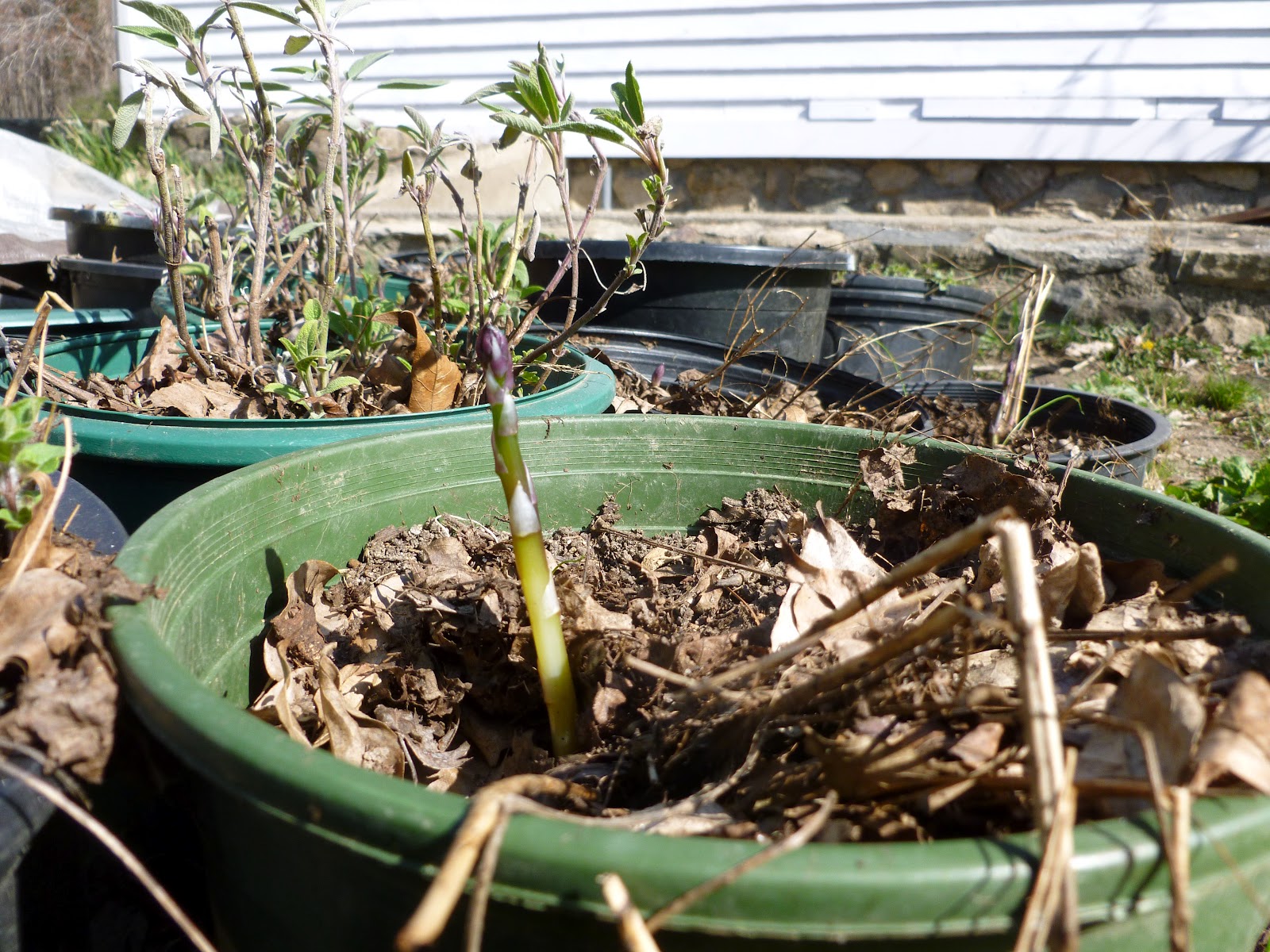
Last year we planted asparagus from seed. This is a long-term project - we won't be harvesting fresh springtime asparagus until 2014 and once we transplant these plants out, they'll be there for decades. But the plants survived this winter and are showing signs of life (see pic). We prepared another patch for these perennial plants, a la John Seymour, and will move them into their permanent homes in the next few days.

Sunday, March 25, 2012

Emergency transplanting!

Digging the holes
This 70-degree record-breaking weather has been nice for many reasons... but it is disrupting the dormancy of our little fruit trees (not to mention big fruit trees, flowers, perennials, insects and everything else). We had been nursery-ing 9 fruit trees to be transplanted out this year to spots we prepped last fall. Following this warm weather, we noticed that our Madison peach and Niitaki Asian pear trees were budding, kicking Jason into emergency transplant mode. You can't safely transplant a tree once it breaks dormancy, and, as we heard from some tree experts in Maine, especially not after the buds open. So we put everything else on hold and are now digging 3-foot wide holes that are 2-feet deep, removing rocks, filling with compost, and transplanting in our now 2-year-old trees. When it rains, it pours (actually, I wish it would rain...).
Starting to bud in the nursery
Transplanted to its new home


Friday, March 23, 2012

Recipe with Brussels sprouts

Brussels sprout slaw w/ blue cheese + orange zest

Ingredients: Brussels sprouts, blue cheese, orange zest, white balsamic vinegar, sour cream, olive oil, s+p

Preparing: Julienne the Brussels sprouts into a slaw. Crumble blue cheese into the slaw. Mix the dressing: white balsamic and a dab of sour cream, s+p, and orange zest (I sliced it into small strips so you actually get bits of it in every bite). Whisk in the olive oil slowly. Add dressing to the slaw and mix well.

Eating: We served it with broiled duck breast and sauteed spinach and garlic.

Dish history: This is a good alternative to the standard B. sprout, parmesan and lemon juice slaw.

Tuesday, March 20, 2012

Broadforking

Our double dug beds are like butter! We are pulling back the mulch and using our locally handmade broadfork to aerate the soil without disrupting its structure. The beds are so impressive - rock-free, soft, the fork goes right in. Getting ready to plants some peas any day now...

Saturday, March 17, 2012

Chicks are here!

Our house is full of little things... a little baby, little seedlings, and now, 30 little chicks. They arrived at the Garrison post office on Thursday morning. Jason picked them up peeping and chirping away in a small box and got them right into their 95 degree brooder. He dipped each chicks' beak into the water so they could learn how to drink, and then they were off on their own... eating, walking, crawling all over each other, drinking, pooping. Getting the temperature right was a challenge, but they seem to be happy now. They'll be in the brooders for a few weeks before we set them out into the real world in their coop.
Tuesday, March 13, 2012

Spring farm update

At this time last year, the feet of snow had just melted, the fields were soaked, and we had a spring stream running through our farm. We had not gotten in the ground yet, days were still bitter cold, and we were desperately burning a gigantic burn pile right smack in the middle of our garden. We both had cases of poison ivy from clearing brush along our fence line, our soil sample was being analyzed in a lab, and we were just becoming familiar with seeding.

This is quite a different year. Seneca Ray is doing a good job distracting us, but the farm must go on.

Jason has been sowing flats of seeds, he's been preparing beds in our upper huerta, and Nick has been broadforking beds in our lower huerta. We checked on the mushroom logs in the pine fields and they are so dry from a lack of snow cover this year, no sign of mushroom life just yet. I wonder if it even got cold enough this winter. We'll see in April when we shock some logs to test our experiment. Our garlic is shooting up and I'm checking with experienced farmers to see if this is ok for the plants. The pastures are bone dry and crackling under our feet as we walk the land. We see the start to our rain catchment system, feeling badly for not getting the roof on in time, but laughing a little since there was never any snow or rain to catch. There's still more double-digging to do, 6 beds worth, but we've got two months to get them ready for our tomatoes which will be transplanted out end of May.

More updates to come, as the work slowly goes on.

Sunday, March 11, 2012

Spring baby!

Someone wanted to put our farming on hold for a few weeks... baby girl Seneca Ray has been born! We're all settling into the farm together, happy and healthy.

Saturday, March 3, 2012

In lieu of a greenhouse

At this time of year, all we are thinking about is starting seeds.

Since we still haven't built ourselves a greenhouse, we've rigged one up in honor of our days on the farm in Patagonia. We have a bed that gets full sun all day that we've been putting our winter's compost on. The decomposition in the 12-inch-layer of composting organic matter gives off some heat. Then we put our "seed trays" (salvaged milk and soda crates) on top of the warm earth and cover them with two layers of greenhouse plastic. We'll check the temperature for the next few days to see how cold or hot it gets in there - wanting close to 70 degrees during the day and not dropping below 50 at night. Now, Monday's task: sow hundreds of seeds.

Tuesday, February 28, 2012

Starting seeds

The end of February marks seed starting season for farmers. Even though we're technically 11 weeks before the last average frost date in our region, we sow seeds for vegetables that we want to have early in the season (e.g., spinach, scallions, lettuce, kale) and that have a long growing season so need a head start (e.g., parsley, fennel, chives, leeks). For the next several weeks we'll start seeds in organic potting soil in the sunniest part of our house, outside protected in our cold frame under double plastic, or directly outside in sunny spots under double plastic. If we had a greenhouse, we'd be starting seeds in there.

Here's to a productive 2012 season!

Saturday, February 25, 2012

Back to the rocks


These spring-like days have drawn us back outside to prepare for approaching planting. Was this a sufficient break from the hard, outdoor labor we did all last year? Are we really ready to get back to the rocks?